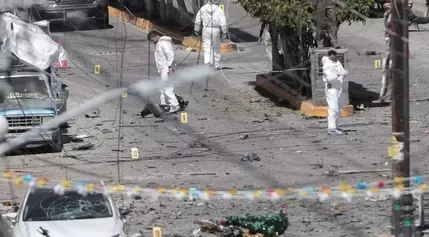
Mexico's ongoing struggle with cartel violence has taken a particularly alarming turn in the state of Guanajuato. Recent attacks involving car bombs, explosions, and other acts of narcoterrorism have shaken the region, leaving authorities scrambling to restore order and understand the motives behind these brazen displays of criminal power. As the new governor seeks to address the crisis, experts debate the nature of these incidents and the broader implications for the country's fight against organized crime.
Guanajuato: Ground Zero in Mexico's Cartel Conflict
Explosions Rock Guanajuato
The state of Guanajuato has been rocked by a series of explosions and attacks that have left authorities and residents reeling. In the city of Acámbaro, a car bomb attack outside a police station resulted in at least three officers injured, seven vehicles burned, and extensive property damage. Just hours earlier, in the nearby city of Jerécuaro, another attack was reported: a car exploded, and several others were set on fire, including a patrol car. While no deaths were reported, the incidents have heightened the sense of insecurity and fear gripping the region.Guanajuato has become the Mexican state with the highest number of intentional homicides, with 1,863 open murder investigations this year alone. The new governor, Libia Dennise García Muñoz Ledo, who took office less than a month ago, has vowed to address the crisis, announcing a coordinated land and air operation to apprehend those responsible and suspending her public agenda to focus on the emergency.
Narcoterrorism or Political Turmoil?
Analysts are divided on the nature of these attacks, with some attributing them to the onset of a new political cycle and the reshuffling within the state government. According to analyst David Saucedo, the "attitude of resignation" among outgoing officials has coincided with criminal groups' intent to send a "strong message" to incoming leaders, as they seek to dominate local governments and undermine their credibility.However, other experts, such as Víctor Hernández from Tec de Monterrey University, are hesitant to classify the explosions as acts of terrorism, arguing that the classic definition of terrorism, involving the use of violence to achieve political or religious objectives, may not apply in this case. Hernández suggests that organized crime is primarily interested in having the government in its pocket, rather than attempting to take control of the Mexican state and replace it.This debate has also infiltrated Mexican politics, with the National Action Party (PAN) and the Institutional Revolutionary Party (PRI) labeling the attacks as "acts of terrorism," while the left-wing Morena party tends to downplay the incidents of violence, accusing the media and opposition of "exaggerating."
The War in Guanajuato
The ongoing conflict between the Santa Rosa de Lima Cartel and the Jalisco Nueva Generación Cartel has been the driving force behind the wave of violence in Guanajuato. Analyst David Saucedo believes that the Santa Rosa de Lima Cartel is likely behind the recent attacks, as the municipalities targeted are considered areas of influence for that group, and the use of explosives aligns with their modus operandi.The Santa Rosa de Lima Cartel has a history of employing explosives, including incidents such as the abandoned van laden with explosives outside a refinery in Salamanca, the car bomb left outside the refinery that failed to detonate, and the "gift bomb" delivered to restaurant owners in Salamanca, resulting in two deaths and five injuries.Conversely, analyst Víctor Hernández suggests that the tactical use of explosives may point to the Jalisco Cartel, which he describes as a "violent, bloodthirsty, and predatory cartel of the local economy." Authorities have yet to release their initial findings from the investigations, and it is possible that each group may attempt to incriminate its rivals to draw law enforcement attention.
The Spread of Cartel Tactics
The use of bombs, grenades, and drones has not been limited to Guanajuato. In Michoacán, the Jalisco Cartel has been reported to employ antipersonnel mines in rural areas, and a bomb threat was recently reported at a shopping center in Morelia, the state capital. Last week, a homemade bomb was deactivated in Sinaloa amid ongoing disputes between Los Mayos and Los Chapitos.Hernández points out that the Sinaloa Cartel has formed pragmatic alliances with the Santa Rosa de Lima Cartel to launch incursions into Guanajuato and combat their common enemy, the Jalisco Cartel. He compares incidents like the drone attack in Tepalcatepec, Michoacán, to scenes witnessed during the invasion of Ukraine, highlighting the increasing sophistication and lethality of cartel tactics.
Arresting Leaders: A Failed Strategy?
The arrest of José Antonio Yépez Ortiz, known as "El Marro," the former leader of the Santa Rosa de Lima Cartel, was hailed as a major victory for the López Obrador administration's efforts against organized crime. However, experts like Hernández argue that this strategy of arresting high-profile leaders has failed to reduce violence, and in fact, often exacerbates it in the medium term.Saucedo is also skeptical about the effectiveness of the government's approach, questioning whether there will truly be a shift under the leadership of Guanajuato's first female governor and Mexico's first female president. He argues that the "narrative of drug trafficking is more powerful than the government narrative," and that the authorities are only offering "plans and ideas," while the drug traffickers "fight with blood and fire."As the crisis in Guanajuato deepens, the debate over the nature of the violence and the appropriate response continues. With the new governor's efforts to restore peace and the ongoing power struggles between rival cartels, the future of the region remains uncertain, leaving both authorities and residents grappling with the consequences of this escalating cartel conflict.